Wednesday, February 28, 2007
The End of Chapter Four
Not much to say about today. We finished Chapter 4 and talked a bit about the exam. Hopefully, everyone will be well-prepared and it will be a positive experience for all!

Monday, February 26, 2007
TCA/Krebs/Citric Acid cycle

Today we made it most of the way through the above-named cycle. For our purposes, the important point is that we start with oxaloacetate, bring in an equivalent of our friend acetyl-
CoA, and then spit out two equivalents of CO2, regenerating oxaloacetate in the process. Lots of familiar processes popped up: NAD+/NADH, E1cb/1,4 addition of water, aldol reaction, decarboxylation........it is worth your effort to make sure that you understand how these processes will work on various organic substrates.
On Wednesday we'll finish up the cycle and get ready for Friday's exam.
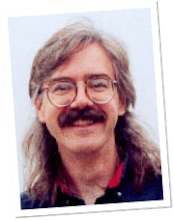
The picture is of Hans Krebs.
Friday, February 23, 2007
What about that pyruvate?

No doubt you've always wondered what to do with all of that pyruvate floating around in your body. Now you know a few different things: lactate, ethanol, and acetylCoA all come to mind.
We learned a new system today: TPP ylid, which works as a place-holder for pyruvate, allowing use to add nucleophiles to the C=O. Depending on the nature of the nucleophile, we can effect either an oxidation or reduction of the original pyruvate.
Problem set will be posted later today.
Wednesday, February 21, 2007
Finishing glycolysis, starting gluconeogenesis

As the title says, we finished glycolysis and started gluconeogenesis. As always, the key is to recognize reaction patterns and think about how they could be used to make a system undergo a particular transformation.
The picture, of course, is Keanu "Neo" Reeves.
Monday, February 19, 2007
Glycolysis

Today we started to look at glycolysis, step by step. We made it about half-way through the process, having broken a six-carbon species down into two equivalent three-carbon species. The "big-ticket" items that we saw included: the use of keto-enol tautomerism to "slide" a carbonyl down a carbon, a retro-aldol to break the six-carbon carbohydrate into two separate three-carbon species, the idea of oxidizing an aldehyde by adding a heteroatom nucleophile and then abstracting a hydride with NAD+, and the concept that all of this can also be done by attaching the molecule to an enzyme covalently through a lysine residue to form an imine.
We'll finish this off on Wednesday and then look at the reverse process.
The picture is of boxing legend "Sugar" Ray Robinson.
Friday, February 16, 2007
The End of Chapter Three
Today we finished our treatment of the biosynthesis of fatty acids. This was the end of the material that we will cover in chapter three. We then had a look at some of the big topics that came up in this chapter: catalytic triad, FAD/FADH2 redox, NADH/NAD+ redox, ATP for making leaving groups at carboxylic acid centers, biotin/bicarbonate-mediated manufacture of CO2, non-H pro-R and pro-S atoms, etc.
Thursday, February 15, 2007
Fatty Acid synthesis
Yesterday we started to look at the process by which acetylCoA is converted to fatty acids (the reverse of the process that we had been studying). The major new process was the use of biotin-mediated reaction of ATP/bicarbonate/acetylCoA to transfer a carbon dioxide to acetylCoA and manufacture malonylCoA. We also saw that there were a number of transthioesterifications and the use of our friend NADH in a reduction, followed by an E1cb elimination. We'll finish this off tomorrow.
Monday, February 12, 2007
Chopping Up Fatty Acids

Today we continued our look at what happens to by-products of triacylglyceride catabolism. The topic was the degradation of fatty acids to acetyl-CoA. In order to understand the process it was necessary to learn the inner workings of a new redox system -- FAD/FADH2. The difficult issue here is that you must use both "fishhook" arrows and regular electron pair arrows as part of the same mechanism. Once over that issue, it is generally not too bad.
The last part of the degradation involved a 1,4 addition to an alpha, beta unsaturated thioester, an NADH/NAD+ oxidation and a retro-Claisen. All are things that we have seen before, it is just a matter of being able to get our hands around them in the more complicated-looking world of biomolecules.
The dog pictured came up when I did an image search for "FADH2." Perhaps that is his name.
Sunday, February 11, 2007
Chapter 3
We finally started looking at real bioorganic chemistry on Wednesday and Friday. On Wednesday we looked at lipid metabolism and learned how biological systems use the catalytic triad as a way of manufacturing hydroxide for a reaction, but keeping [hydroxide] equal to (essentially) zero. In this way, fatty acid esters are converted to alcohol and carboxylic acid. Here, it is all about the electron flow.....
We also saw how to go backwards from acid and alcohol to fatty acid ester. This process a little more complicated and required that we use acetyl-CoA to create thioesters and ATP to create acyl phosphates from carboxylic acids.
Friday's focus was on the conversion of glycerol to dihydroxyacetone phosphate. Several important points came up in this one: you don't need to limit pro-R and pro-S designations to hydrogens (we saw how to label the CH2 groups in glycerol), the ATP-mediated phosphorylation is used again (this time on an alcohol instead of an acid), and the use of the NAD+/NADH system to mediate redox chemistry. This last part was the hardest, requiring that we understand how NADH acts as a stereospecific source of hydride and how NAD+ acts as a hydride acceptor in what is essentially an elimination of dihydrogen from across a C=O bond.
We also saw how to go backwards from acid and alcohol to fatty acid ester. This process a little more complicated and required that we use acetyl-CoA to create thioesters and ATP to create acyl phosphates from carboxylic acids.
Friday's focus was on the conversion of glycerol to dihydroxyacetone phosphate. Several important points came up in this one: you don't need to limit pro-R and pro-S designations to hydrogens (we saw how to label the CH2 groups in glycerol), the ATP-mediated phosphorylation is used again (this time on an alcohol instead of an acid), and the use of the NAD+/NADH system to mediate redox chemistry. This last part was the hardest, requiring that we understand how NADH acts as a stereospecific source of hydride and how NAD+ acts as a hydride acceptor in what is essentially an elimination of dihydrogen from across a C=O bond.
Monday, February 05, 2007
Friday, February 02, 2007
Finishing Chapter 2
Some basic p-chem stuff today, mostly about how enzymes do their enzyme thing and how the energy of the system is manipulated by biological systems by coupling an exergonic process (often hydrolysis of ATP) to a needed endergonic process.
We also went over question #10 from the end of Chapter 2.
We also went over question #10 from the end of Chapter 2.
Subscribe to:
Posts (Atom)